News
Arrest
The Separatists are held in Boston
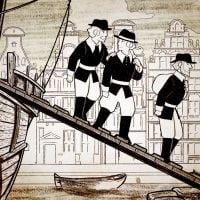
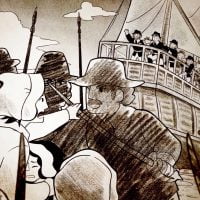
After making their way to the Lincolnshire coast near Boston, the Pilgrims were hoping to escape from England for new lives in Holland. But their secret escape plan was thwarted after they were betrayed by the master of the ship who had agreed to take them to Holland. Their ordeal in Boston was recalled by William Bradford in his diary years later:
“Being thus first, by the catchpole officers [sheriff’s deputies], rifled, & stripped of their money, books, and much other goods, they were presented to the magistrates, and messengers sent to inform the lords of the Counsel of them; and so they were committed toward.”
Escape #1
Sixty miles to the coast: attempting to flee from Boston
Once the Separatists made their minds up about fleeing from England in search of tolerance in Holland, they needed to find a means of escape. They were living inland, in Nottinghamshire and around Gainsborough, so they needed to make their way to the coast.
Secrecy
Separatists forced to live secret lives
Religious life changed dramatically throughout the course of the 15th and 16th century. As each monarch changed, there were big changes in the way the Church expected people to practise their faith – and everyone was expected to follow the Church’s rules. If you didn’t, you were likely to find yourself before the Church courts facing a fine or worse.
Tolerance
Seeking tolerance, spreading intolerance
Some of the early leaders of the Pilgrims/Separatists made important arguments in favour of religious tolerance at a time when this wasn’t a universally recognised right. By raising these issues, they began important conversations about what people should be allowed to do in their lives.
At this time, people were put in prison – and died – for their religious beliefs. The Gainsborough Separatist leader John Smyth began to argue for tolerance of all strands of Christianity whilst in exile in the Netherlands.
Faith
The Pilgrims and providence
The Pilgrims had a strong belief in ‘providence’, which means the intervention of God’s will. They often saw providence in things that happened to them on their journeys, and it’s something William Bradford mentioned in his diary of their journeys and lives, Of Plimoth Plantation.
By holding this belief, it seemed to help them carry on, even in the face of what might have seemed to others insurmountable challenges. It’s important to remember too that at this time, four centuries ago, this was a time before modern science, medicine and technology which might have explained the way things in the world were differently.
Persecution
Becoming Separatists and risking all
“But after these things they could not long continue in any peaceable condition, but were hunted & persecuted on every side, so as their former afflictions were but as flea-bitings in comparison of these which now came upon them. For some were taken & clapped up in prison, others had their houses beset & watched night and day, & hardly escaped their hands; and the most were fain to flee & leave their houses & habitations, and the means of their livelihood.”
This is how William Bradford, Pilgrim chronicler and Plymouth colony Governor, recollected the plight the Separatists had faced in England before they fled to Holland.
New ‘Radical Routes’ online edition reflects on Pilgrim anniversary
A new online publication is released today as part of West Lindsey District Council’s PilgrimAGE season to commemorate 2020’s Mayflower anniversary. The ‘Radical Routes’ reader has been produced in collaboration with other leading arts programmes in the region.
Originally planned as a newspaper-style publication, due to challenges arising from the current coronavirus crisis, ‘Radical Routes’ has now been produced in an online format so it can be shared widely across Lincolnshire and further afield. West Lindsey District Council’s Mayflower 400 cultural programme has worked with the University of Lincoln’s Transported programme, bringing arts to people in Boston Borough and South Holland, and Bassetlaw’s ‘The Few to the Many’ project to create an arts-led response to the region’s role in the Pilgrims’ heritage story.
Continue reading “New ‘Radical Routes’ online edition reflects on Pilgrim anniversary”
An act of kindness goes a long way
The generosity and kindness that has been displayed across the country recently reminds us of one of the leading separatists, William Bradford and his inspirational words that united people around the world 400 years ago.
“as one small candle may light a thousand, so the light here kindle hath shone unto many”
He is referring to their struggles and efforts leading up to their arrival in America and that it would serve as a light that will inspire many more to follow them (the way one small candle can light a thousand).
Separatists
The Two Congregations
Who were the ‘Separatists’? How do they relate to the ‘Pilgrims’?
Four centuries ago, the Church of England was the established Christian church of the state, set up by King Henry VIII following his battles with the previously established Church in Rome.
Religion played a hugely important role in everyday life for everyone, but it was a divisive issue. Separatists were people who wanted, for a variety of reasons, to separate themselves from this Church.
Separatists are sometimes compared to Puritans, but the Puritans wanted to ‘purify’ the Church from within, rather than leave it altogether.
This was a time when it became easier for more people to read more things, and to publish their own writing. The printing press had been invented in the fifteenth century, and it had changed the world – much like the internet has done for us today.